Some of these reactions are exothermic releasing energy. Glucose molecules are transported across cell membranes by facilitated diffusion or active transport.
2
Energy or fuel from our food is used for cell growth repair and normal cell functioning.

. Glucose is a 6-carbon structure with the chemical formula C6H12O6. The energy released is used in. Glucose then moves into the blood through the permease in the membrane between the cell and the bloodThus ATP is used as an energy source to drive Na out of the cell resulting in glucose transport from the intestine to the blood.
Glucose and sodium move from the lumen hollow space of the small intestine into the blood via transport proteins in the epithelial cells lining the small intestine Figure 1. D His cells have a. Both the NaK Pump maintain the sodium concentration gradient.
During aerobic metabolism oxygen is pulled from the blood and into the cell with the glucose. Crops use light energy to produce photosynthetic products. It is a ubiquitous source of energy for every organism in the world and is essential to fuel both aerobic and anaerobic cellular respiration.
Unit 2 Free Response Question 2 Mya Wigley The direct source of energy used to move the glucose into the epithelial cell from the intestinal lumen would be from the sodium gradient. Explain how the transport of sodium ions is involved in the absorption of glucose by epithelial cells. The energy-requiring phase above the dotted line in the image below and the energy-releasing phase below the dotted line.
This process involves digestion absorption and transportation. Membrane proteins must have an asynchronous distribution on the cell membrane for the system to function. The energy requiring step for co-transport.
The mitochondria uses the oxygen to burn the glucose into heat energy and adenosine triphosphate ATP. When glucose molecules move into the cell by facilitated diffusion the concentration gradient plays. Most commonly carbohydrate metabolism results in the production of glucose molecules which are the most efficient source of energy ATP for our muscles and our brains.
Describe how crop plants use light energy during the light-dependent reaction. From the epithelial layer to the blood the GLUT 2 Transporter is used this allows the glucose to go straight from the epithelial layer to the blood speeding up the process. The permease that allows glucose and Na into the cell requires ATP.
In this phase the starting molecule of glucose gets rearranged and two phosphate groups are. The Na K ATPase that pumps Na from the cell into the lumen of the intestine. In chemiosmosis what is the most direct source of energy that is used to convert ADP i.
This process involves digestion absorption and transportation. Glycogen a polymer of glucose is a short-term energy storage molecule in animals Figure 1. Glycogen is made and stored in the liver and muscle.
When there is plenty of ATP present the extra glucose is converted into glycogen for storage. If glucose is the sole energy source what fraction of the carbon dioxide exhaled by animals. Once the glucose has entered the cell the cell works to burn the glucose to create energy.
This is done through a process called aerobic metabolism. 5 marks Unit 4. Glucose is absorbed from the lumen of the small intestine into epithelial cells.
The permease that pumps glucose from the cell into the blood requires ATP. Glucose often enters the body in isometric forms such as galactose and fructose monosaccharides lactose and sucrose disaccharides or starch. Energy from the sodium gradient 2.
Many carbohydrate molecules can be broken down into glucose or otherwise processed into glucose by the body. His cells cannot move NADH from glycolysis into the mitochondria. Glycolysis and TCA tricarboxylic acid cycle or citric acid cycle.
- Energy from the sodium gradient - The NaK pump maintains the sodium concentration gradient and allows for the contransport of glucose. C His cells lack the enzyme in glycolysis that forms pyruvate. Most commonly carbohydrate metabolism results in the production of glucose molecules which are the most efficient source of energy ATP for our muscles and our brains.
These reactions are divided into 2 main stages ie. The NAK pump maintains the sodium concentration gradient and allows for the cotransport of glucose the symportinflow of glucose maintains a glucose concentration gradient between the epithelial cells and the blood and allows for facilitated diffusion of glucose ATP is the energy used. - The microvililifolds on the lumen side of the epithelial cell provide more surface area for uptake of glucose into the epithelial cell.
Glycolysis takes place in the cytosol of a cell and it can be broken down into two main phases. Active transport indirectly requires energy from the hydrolysis of ATP. Energy or fuel from our food is used for cell growth repair and normal cell functioning.
The glucose molecule is broken down into carbon dioxide and water by undergoing a series of reactions in aerobic respiration. This maximizes the source of absorbing the glucose because it is an easier faster way for the glucose to be processed and moved. Most of the time the former process takes place as it requires no energy from the cell.
And allows for the cotransport of glucose and the folds on the lumen side of the epithelial cell provide more surface area for. Based in Figure 1 describe the direct source of energy used to move glucose into the epithelial cell from the intestinal lumen.
2
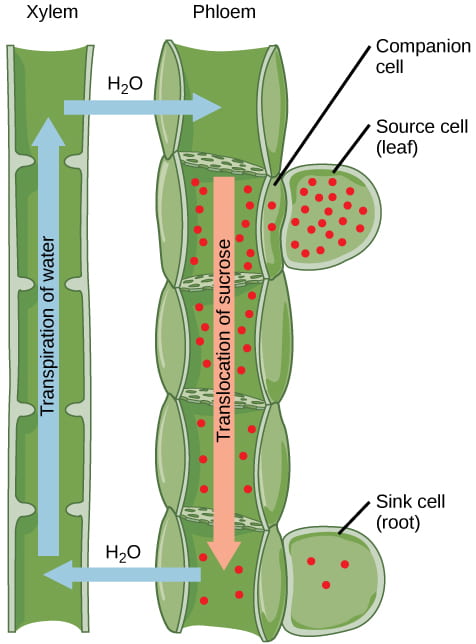
Sugar Transport In Plants Phloem Organismal Biology
Glucose And Sodium Move From The Lumen Of The Small Intestine Into The Blood Via Transport Proteins In The Epithelial Cells Lining The Small Intestine Figure 1 Flashcards Quizlet
Glucose And Sodium Move From The Lumen Of The Small Intestine Into The Blood Via Transport Proteins Brainly Com



0 Comments